
Part 5. Hammer Time.
We meet the auctioneer, zero Toby Jugs and we put fried bread in the pudding.

Okey dokey, off we go again. For the record it’s July 2004, Facebook has been launched and our restaurant buying process is rolling on. But let’s get the boring legal bits out of the way first. We had to tell our solicitor all about what we were doing.It’s kinda like buying a house, but as the premises was leasehold, most business premises are, there’s more to take into account. We had to make sure that there was enough years remaining on the lease, and we had to be certain that there was an option to carry on with that lease when it ended. Our solicitor told us that there were rent reviews every five years, which generally means the rent goes up every five years, never down. But we knew about these points, we’d done our research, don’t you know!
Then we had to hear the nasty thing’s which are often hidden out of view, such as, you have to pay the buildings insurance and the freeholder chooses the policy. It won’t be the cheapest, you’re paying. Then, even though you are the leaseholder, and you're paying rent, you are fully responsible for repairs to the building. Also, if you decide to sell the lease on in the future, and the next leaseholder happens to go bust, the lease goes back to you, and you are again, responsible for the rent and the building. Great. A lose lose situation.
It’s these little titbits that start your brain ticking……backwards, and give you sleepless nights. Wouldn’t it be easier to stay at work, take the money, have a few weeks holiday in Costa Blahblah every year, sit on the sofa on an evening and not be at work every weekend.
But you know what people, if everyone in the world thought like that, nothing would happen, ever.
So whilst all of the above was happening in the background we were sorting the nice bits. There was tonnes of stuff going on but we’re telling you these bits simply because we liked doing them. So, where could we buy old furniture from? Car boot sales were a bit hit and miss and antique shops labelled dusty things as Edwardian, and tripled the price. But what about auctions? We’d never been to one before, so all we knew about them is what we had seen on the TV. To be honest, they looked a bit scary. It seems that you had to stand upright like a granite column and keep your eyes fixed on a nail sticking out of the wall on the other side of the room. And if you moved, oh no, you’ve just bought a used Sodastream for £14,000.00.
Actually we found out they were nothing like that. This particular auction house was in a market town called Darlington, or as it’s more commonly known, by the locals, Darlo.
So we went to have a look at the gear a day or two before, and placed a little star next to the items we liked in the pamphlet which they gave us. They called it a brochure, but it was a pamphlet. There were some pretty low guide prices next to the items in the list, that gave you a vague idea of what they would sell for, and built your hopes up also. On the auction day Donna was still working so I went on my own. First up, I signed my name in a book and gave my details, then they gave me a number and babbled on about the rules, I didn’t listen to that bit. Then I took a seat in amongst all the furniture and ornaments and waited. I remember feeling a bit miffed that the first desirable object, or Lot as us professionals say, was something like number 89. What was I going to do until then? Look at my phone, check Twitter, check Instagram? Oh, wait, they didn’t exist. And it didn’t matter really, I shouldn’t have been miffed at all, because the auctioneer must have had amphetamine sulphate sprinkled on his Cornflakes that morning, and he was speaking a new language, the only word I could pick up on was ‘sold’. It was crazy fast, like he just wanted to get it done and go home.
So, between Lot 1 and Lot 89 I had to learn this new, super Speedy (pun intended) language. Luckily I did, because within ten minutes we were there, Lot 89.
Now basically, what I had learned is that first of all the auctioneer is telling us what it is, let’s say, Lot 14, a standard lamp and a milk churn, and then he gives a starting price. Someone puts their number up in the air if they want it, then he shouts out more numbers until someone offers the most money. Then, the best spendy person gets the prize. And it feels like a prize at this stage, even though you’re paying for it. I was ready.
So, Lot 89 comes up, in Speedy language he tells us it’s three chairs and a wash stand, we didn’t really want the wash stand, but there wasn’t a choice. He starts the bidding at five quid. Yes, five quid, a bargain. Now, nobody bids, so I didn’t, he asks for a fiver again, nothing. He looks around the room and I’m getting ready to wave my number, hoping that nobody else has a twitchy hand. I let the room pause for a few more seconds, and then I did it. I flicked up my number as if I couldn’t give monkey’s ding dong wether I get it or not, he nods at me, then looks around for other bidders, as do I. Jesus it’s jittery stuff. Then that’s it he, whacked his gavel on the desk and then snaps, “sold”, and notes my number. Just like they do on the telly. What a bargain, unbelievable.
I decided not to buy anything else at this auction, this was just a test run, plus adrenaline was oozing from my seams.I paid the five pounds, plus the auctioneers fees and VAT, wasn’t much extra, collected the stuff and went. Pleased as punch.
I got home and told Donna that same story, and after that we went to as many auctions as possible, collecting all the furniture and decorative gear we could. It was addictive. Sometimes we walked away with nothing, sometimes it looked like we were collecting for a bonfire. And Donna usually went home with an extra goodie, such as a Cornishware flour sifter.
Oh yeah, quick story, we went to an auction in a place called Hartlepool, there was loads of decent, dusty furniture. We set ourselves up, twitchy number at the ready, then what happened surprised us. The items we wanted, oak chairs from the fifties and sixties, barley twist wooden tables, and so on, were getting snapped up at two pound each, by us, and only us. Yet bikes, TV’s, Ikea furniture and electronics were being bought at prices similar to shop prices. Baffling. There we go, auctions are great. If you’ve never been, go.
Now then, crockery and cutlery, seems straightforward doesn’t it? It actually isn’t. We visited a place in Newcastle which was like a warehouse of everything you put on a restaurant table and more. We chatted with this bloke and told him what we were up to. Now obviously, as soon as we mentioned that it was going to be a vegetarian restaurant, he pulled us down the aisle towards the terracotta tagines, the plates with swirly patterns on them, wine glasses that were as clunky as Toby Jugs and all the other stereotypes he knew of. This put me in a bit of a huffty. Donna was being polite while I was mumbling about how stupid this guy was. Note at this point Donna was always best suited to Front of House than me.
However, when we straightened him out he started to click. He started showing us a range which was called Porcelite, plain white crockery, tough yet understated and of course, at a decent price. Then the cutlery, again we didn’t want those things with plastic handles, or the those flat, weightless things that bend when you cut into mash. You know, the ones in Beanbag Cafe. This bloke was getting us now, so he showed us something with a pattern called Rattail, simple and almost retro. Perfect.
But then he asked how many pieces we wanted. This is possibly the hardest mathematical problem to solve. If Carol Vorderman had to do this, she would have given up and ran straight out past the Toby Jugs, screaming and pulling her hair out.
It goes like this, we knew we had twenty eight covers, so logic says the same amount of main course plates. Well yea, but not everyone would be having a main course at the same time. But what if they were. And starter plates, you don’t need twenty eight as not everyone would be having a starter at the same time. But then the warehouse geezer came out with the possibility of using some starter plates for desserts also. Oh great, that helps. Soup bowls, would we need the full amount? What’s the point of having twenty eight when not everyone would be having soup. Cutlery, this would depend on table settings. Are we putting out the full starter, main and dessert table setting. Decisions, decisions! Would we just wrap them in a napkin? Definitely not. Did we need to put out dessert cutlery if not everyone was having dessert. Plus lunch and evening menu were going to be different. Lunch, informal and evening, formal. So what did we need? Numbers were bouncing around and we were getting nowhere.
Oi Carol, wait for us.
But as we all know, everything gets there in the end, and the guy told us that if we needed more we could always have some sent down in a parcel. So we placed our order and asked him to hold onto it until were closer to opening the restaurant.
There we go, a couple of stories this week about getting set up for a restaurant. Obviously there was food costing and pricing going on, a drinks menu being put together, searching for suppliers organising an alcohol license……the list goes on and on.
Plus the menu, we were deciding what to put on it, and what definitely not to put on.
This is just a snippet of what was actually happening, if we told you everything, this Substack would state Four Hour Read.
Recipe time. One of the early ideas at the time was a savoury bread and butter pudding. Now, this has been done to death over the years, but at the time, it hadn’t. So it was a Vintage Cheddar and Caramelised Onion Pudding With A Sticky Ale Reduction. Bloody lovely.
Anyway, here’s a recipe for a slightly updated version. In this one we’ve added tomatoes and upped their flavour and instead of just plonking the bread in it’s been fried first.
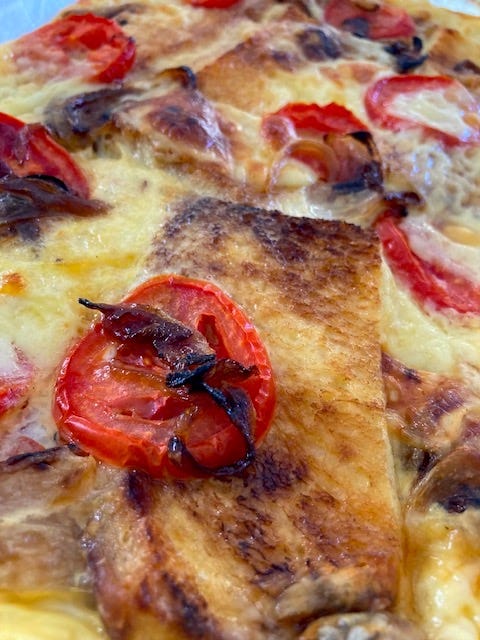
Serves about three or four, that depends on you.
Fried Bread, Cheddar and Sticky Onion Pudding
Ingredients
-750ml whole milk
-5 free range eggs
-6 slices white bread, each cut in half
-1 medium onion, peeled and finely sliced
-2 medium tomatoes
-1tbsp tomato purée
-250g good strong Cheddar, sliced into ½ cm slices, roughly
-salt
-sugar
Method
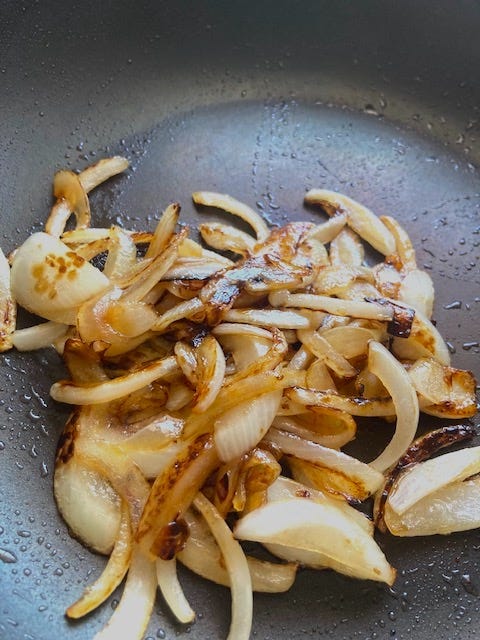
-In a frying pan, heat a little oil, then fry the white bread on both sides until golden. Place the fried bread on a piece of kitchen roll for now.
-Give the frying pan a quick wipe, then add a little oil and fry the onions until golden brown. Then add a teaspoon of sugar, allow to go sticky for 30 seconds, season with a little salt.
-Heat the milk in a saucepan until just tepid, you should be able to touch it without burning yourself. Turn it off and leave it. This is to speed the cooking up.
-In a bowl, beat the eggs with 1 teaspoon of salt.
-Pre heat your oven to gas mark 4, or 180c.
-Now slice the tomatoes thinly, then smear a little tomato purée onto each one. That’ll give them a lift.
-In an oven proof dish (about 20cm by 25cm but don’t worry too much about the size) either line it with baking paper or brush the bottom and sides with oil.
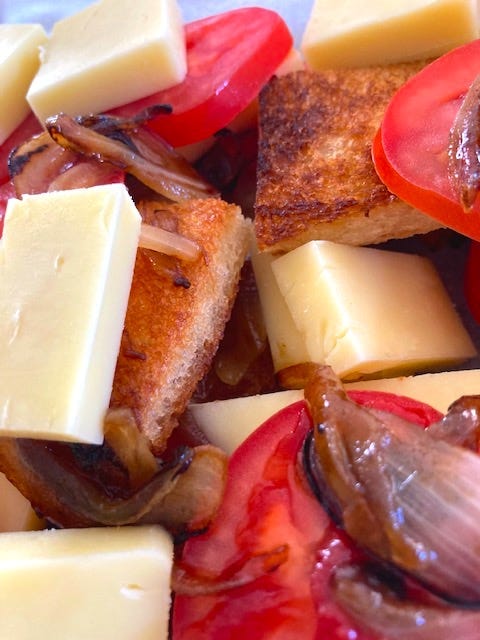
-Add half of the fried bread, now half of the onions, then half of the tomatoes and finally half of the Cheddar. Do the same again for the next layer.
-Pour the warmed milk onto the eggs, mix well.
-Tip- Take the dish close to the cooker before you add the liquid. Then pour the mix over the other ingredients, dunk them down a bit and pop in the middle of the oven and cook for 30-35 minutes.
-Keep an eye on it, it’s done when it just starts to rise, if it puffs up too much it goes a bit watery.
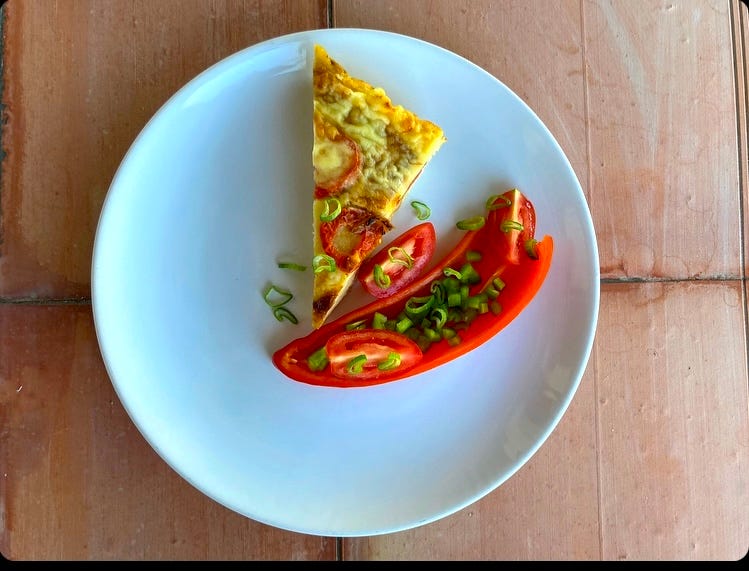
-Eat it. Or leave to go cold and and eat it. Honestly, it’s quite nice when it’s cold. After all, isn’t it basically a form of quiche?
See you all next week as we continue to work through our massive list of jobs, including, upholstery, putting the restaurant menu together and collecting the keys from a miserable solicitor.
Crikey: those leasehold rules! They'd be enough to make Jacob Rees-Mogg blush!
Well I never knew that was called rat tail cutlery. You live and learn!